
Hacking the Logos

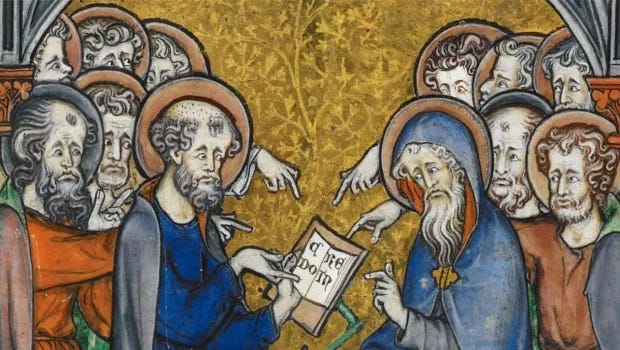
Late 1st century: a Stoic, a Platonist, and a Jew are debating about the Logos, the divine creative power governing the universe.
The Stoic argues that the Logos is essentially identical to both God and the Cosmos, which are one and the same thing.
The Platonist contends that God and the Cosmos are distinct, and that the Logos is an intermediate principle; it is the Mind of God, or the Form of the Cosmos.
The Jew says that the Logos is a Jew.
This is not a joke. It is a parable for the Christianization. And the least funny thing is that the Jew ultimately won the debate and converted the whole Roman Empire to his view.
Here is how it happened.
How the Logos was made flesh
In my previous article, I showed that the promise of sharing in Christ’s resurrection by consuming his flesh and blood in an ambiance of Mystery Cult, sums up what the converts were offered by Paul and later missionaries of the Pauline tradition. As far as we know, this attracted mostly the poor and downtrodden, at least until the middle of the second century. The resurrection of rotting corpses was a grotesque idea for any philosophically-minded Roman. Even in 410, when bishops were recruited among the upper class, Synesios of Cyrene, a skilled Neoplatonist philosopher (and a student of the mathematician Hypatia, lynched by a Christian mob in Alexandria in 415),[1] stated in an open letter before his ordination: “This resurrection, which is an object of common belief, is nothing for me but a sacred and mysterious allegory, and I am far from sharing the views of the vulgar crowd thereon” (Letter 105). We must assume that many of his class expressed similar reservations in private, while starting a career in the Church.
What did give Christianity an air of philosophical respectability was the high Christology of the Logos. If believing in Christ meant believing in the Logos, then educated Romans could choose conversion over social marginalization, without losing face.
Logos was originally a Stoic concept. It is translated in Christian literature as “the Word,” but the Greek word logos, from which our word “logic” derives, is closer to “reason”. Logos stands in Stoic philosophy for the rational principle governing all things. It is the World Soul, the Anima Mundi. It is practically synonymous with Cosmos, since kosmos means “order” or “harmony”, as opposed to chaos. As Hans-Josef Klauck notes in The Religious Context of Early Christianity, in the second century, “certain essential Stoic ideas had become commonplaces and had entered the underlying structure of ethical thought.”[2] The Logos was such a commonplace. Any vaguely cultivated man understood what it meant. The Logos had found its way into what scholars today call Middle Platonism. But for the Platonists, who make a sharper distinction between God and the World than the Stoics, Logos came to be understood as an intermediate principle. It is the Thought of God, the sum total of Forms or Ideas projected by God.
Whether Stoics or Platonists, philosophers firmly believed that the Logos was present in every man’s rational soul, which is why men have the ability to study how the Cosmos works. But before the 4th century, no Greek or Roman in his right mind could have come up with the crazy idea that the Logos was “made flesh” in the form of one particular man, let alone a Jew crucified under Roman Law. By the end of the century, however, every Roman was instructed by imperial law to believe it.
The idea did not originate from Paul, although 1Corinthians 8:6 may allude to it (Colossians 1:15-17 too, but Paul’s authorship of that letter is disputed). The Logos is also absent from the synoptic gospels. Its first known appearance in Christian literature is in the “prologue” of the Fourth Gospel, consisting of the first 18 verses, starting with: “In the beginning was the Word: the Word was with God and the Word was God. He was with God in the beginning. Through him all things came into being, not one thing came into being except through him” (John 1:1-3). The consensus is that the Gospel of John was written in the last decade of the 1st century, though some scholars date it from the early 2nd century. In any case, Logos theology was fully developed in the second half of the 2nd century, the age of Christian apologists. Irenaeus, who died around 200, says that Christians must believe in
the Logos of God, Son of God, Christ Jesus our Lord, Who was manifested to the prophets according to the form of their prophesying and according to the method of the Father’s dispensation; through Whom (i.e. the Logos) all things were made; Who also, at the end of the age, to complete and gather up all things, was made man among men, visible and tangible, in order to abolish death and show forth life and produce perfect reconciliation between God and man. (Demonstration of the Apostolic Preaching, VI)[3]
There is a disturbing irony in the Christian appropriation of the Logos, for logos basically means “reason” for the philosophers. When early Christian apologists blamed philosophers for putting their faith in “reason” rather than God, and even of worshipping “Reason”, they used the word logos in Greek (Justin Martyr, Tatian, Theophilus of Antioch). But the same authors worshipped Jesus, whom they claimed was the true Logos. They changed the meaning of Logos so radically as to claim that being saved by the Logos required faith rather than reason, to the point of writing, like Tertullian, “it is straightforwardly credible because it is senseless … it is certain because it is impossible” (De Carne Christi 5.4). The Logos, the divine source of man’s reason, has been hijacked by a religion that requires men to surrender their reason to blind faith in impossible things.
It is generally assumed that the Christian authors who forged the Logos Christology, starting with the author of the Gospel of John, were students of the Greek philosophers. This is not the case: they were students of a Jewish philosopher, namely Philo of Alexandria. It was Philo who first Judaized the Logos and laid the ground for the high Christology that would lead to the full identification of Jesus with God.
Philo of Alexandria
Keep reading with a 7-day free trial
Subscribe to Radbod's Lament to keep reading this post and get 7 days of free access to the full post archives.